Mind Map Templates for Startup Founders: Investor Decks, Product Roadmaps, and GTM Plans in Seconds
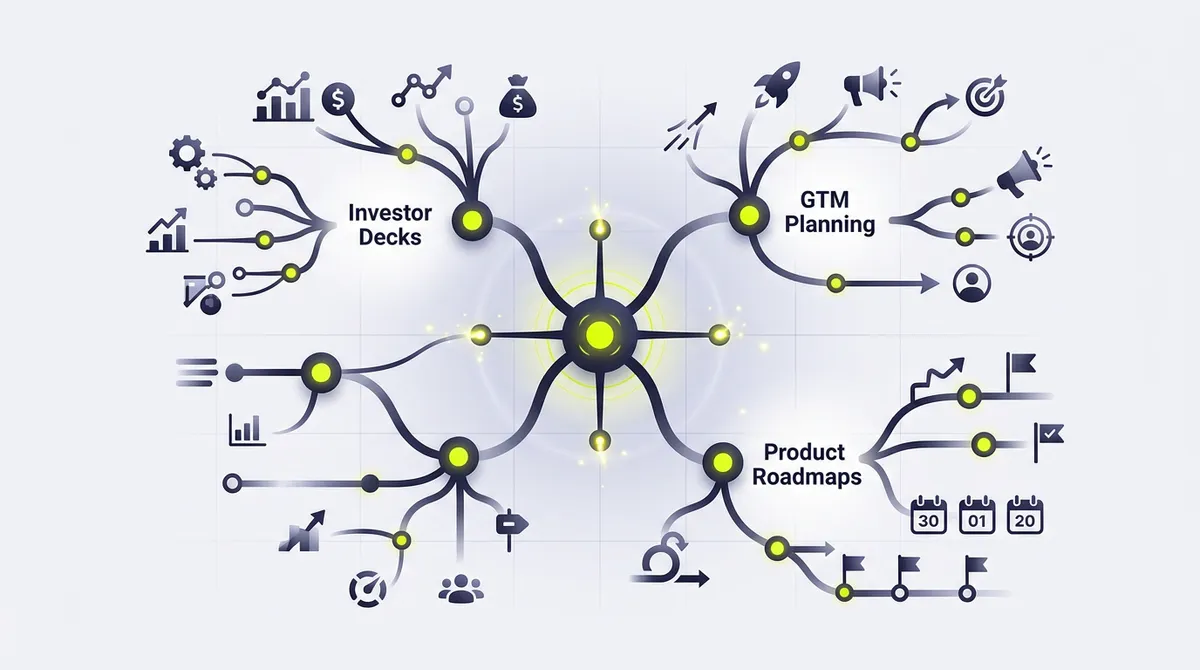
You are raising a Series A. You have 47 investor meetings scheduled over the next 8 weeks. Each meeting requires a 5-minute strategic overview that communicates market opportunity, competitive positioning, product differentiation, go-to-market strategy, financial projections, and team capability. Each investor asks different follow-up questions, which means each meeting requires slightly different emphasis.
You are also managing a 14-person team, shipping a product update, and handling three enterprise deals. The time you have to build visual strategy artifacts: approximately zero.
The Founder's Communication Volume Problem #
Startup founders at seed through Series B stage communicate their business strategy an average of 15-25 times per month across investor meetings, board updates, team all-hands, customer presentations, and partner conversations. Each communication event benefits from a visual strategy artifact that makes the complex story legible in minutes.
The National Venture Capital Association's 2025 fundraising data shows that founders raising Series A meet with 50-80 investors before closing. Each meeting uses a pitch deck (15-20 slides) or a strategy visual (1-2 page overview). The founders who use visual strategy maps -- structured mindmaps that show the entire business in one connected view -- report 22% shorter meeting times and higher investor engagement, according to a 2024 DocSend fundraising analysis.
But building those visuals takes time that founders do not have. A pre-revenue startup founder works 60-70 hours per week (Startup Genome, 2024). Adding 2-3 hours per week for visual deliverable construction means sacrificing product development, customer conversations, or sleep. None of those are acceptable trade-offs.
The communication volume increases with each funding round. A seed-stage founder communicates strategy to 5-10 stakeholders (co-founder, advisors, early investors, early hires). A Series A founder communicates to 20-30 (board, larger team, more investors, more customers). A Series B founder communicates to 50+ (board, executive team, department heads, strategic partners, press). Each incremental stakeholder group requires adapted visuals -- same strategy, different emphasis.
What Makes Founder Mindmaps Different #
Founder mindmaps serve a fundamentally different purpose than employee mindmaps. Employees create mindmaps to organize work. Founders create mindmaps to sell a vision.
Founder mindmaps need narrative coherence. Every branch supports a central thesis: "This market is large, this problem is acute, our solution is differentiated, our team can execute, and the financial opportunity justifies the investment." The mindmap is not just organized information -- it is a structured argument.
Founder mindmaps need credibility signals. Investors evaluate the map as much as the company. A map with specific data points (market size from credible sources, customer metrics from actual usage, financial projections from defensible assumptions) signals that the founder does rigorous analysis. A map with vague claims ("large market," "fast growth," "strong team") signals the opposite.
Founder mindmaps need adaptability. The investor who asks about unit economics needs to see the financial branch expanded with CAC/LTV analysis. The investor who asks about competitive moat needs to see the differentiation branch expanded with technical architecture details. The map needs to serve as both the overview and the drill-down.
Templates Built for Startup Founders #
Investor Pitch Strategy Templates #
Maps the fundraising narrative as a visual argument: market opportunity (TAM/SAM/SOM with sources and methodology), problem validation (customer pain points with supporting data -- survey results, churn reasons, NPS scores), solution differentiation (what the product does that alternatives cannot, with proof points), traction (key metrics that demonstrate product-market fit: MRR growth, retention cohorts, NPS, pipeline), business model (revenue model, unit economics, path to profitability), and team (founding team background, key hires, advisory board).
Use it for: Pre-meeting preparation, investor deck visual supplement, board strategy slides, accelerator applications.
Go-to-Market Strategy Templates #
Maps the customer acquisition engine: ICP definition (firmographic and behavioral characteristics of the ideal customer), channel strategy (paid, organic, outbound, partner -- with CAC estimates per channel), conversion funnel (visitor to trial: X%, trial to paid: X%, paid to annual: X%), pricing architecture (tier structure, anchor pricing, discount policy), and launch sequence (beta with design partners, public launch, scale acquisition). Each channel node includes the budget required and the expected timeline to reach payback.
Use it for: Board strategy sessions, marketing team alignment, investor growth narrative, Series A operational plan.
Business Model Canvas Templates #
Maps the nine business model canvas components as an interconnected system: customer segments, value propositions, channels, customer relationships, revenue streams, key resources, key activities, key partnerships, and cost structure. Each component node includes the startup-specific detail: "Revenue streams: SaaS subscription, $29/mo starter, $79/mo pro, $199/mo enterprise. Average contract value: $948/year. Annual expansion rate: 115%."
Use it for: Business model validation, pivot analysis, co-founder alignment, advisor discussions.
Product Roadmap Templates #
Maps the build sequence as a strategic narrative: current state (what the product does today), near-term (next 90 days -- features in active development with delivery estimates), medium-term (6-12 months -- features in design/research with confidence levels), and long-term vision (12-24 months -- strategic bets with market validation requirements). Each feature node includes the customer problem it solves, the metric it targets, and the competitive advantage it creates.
Use it for: Engineering sprint planning, investor product vision, customer advisory board feedback, team alignment.
Competitive Landscape Templates #
Maps the competitive environment from the founder's strategic perspective: direct competitors (with pricing, feature parity, funding, and customer sentiment), indirect alternatives (the "status quo" solutions customers use before adopting your product), emerging threats (new entrants or adjacent products that could expand into your space), and competitive moat analysis (what defensible advantages your product has -- network effects, data moats, switching costs, brand equity).
Use it for: Investor competitive positioning, pricing strategy, product differentiation decisions, sales battlecards.
How Startup Founders Actually Use Mindmaps #
Based on patterns from 1,400+ founder-created mindmaps:
- Fundraising preparation and storytelling (35% of founder mindmaps). The investor pitch visual. Founders use mindmaps to tell the investment thesis story visually: large market, acute problem, differentiated solution, proven traction, clear path to scale. The map serves as both the pre-meeting preparation tool (ensuring the founder covers all thesis components) and the meeting artifact (showing the investor the full strategic picture in one view).
- Strategic planning and co-founder alignment (25% of founder mindmaps). Before quarterly planning, co-founders use mindmaps to align on strategic priorities. The visual forces explicit trade-off conversations: "If we prioritize enterprise features (this branch), we defer the self-serve growth engine (this branch) by one quarter. What does that mean for our Series A timeline?" The map makes the trade-off visible instead of abstract.
- Team all-hands communication (18% of founder mindmaps). Founders present the company strategy at monthly or quarterly all-hands meetings using a visual strategy map. The map replaces the "state of the union" slide deck with a connected view of company direction. Team members can see how their work connects to the company's strategic priorities, which reduces the "I do not understand how my work matters" disengagement that grows as startups scale beyond 15 people.
- Board meeting preparation (14% of founder mindmaps). Board meetings require a strategic overview that covers company performance, market dynamics, product strategy, financial health, and key decisions requiring board input. The mindmap organizes these topics as connected branches rather than sequential slides, enabling board members to see how a pricing change (financial branch) affects competitive positioning (strategy branch) and customer acquisition (growth branch) simultaneously.
- Customer and partner presentations (8% of founder mindmaps). When presenting to enterprise customers or strategic partners, founders use product roadmap mindmaps to show how the customer's needs fit into the product's evolution. The visual demonstrates that the customer's requirements are not one-off requests but part of a coherent product vision.
The Founder's Time Calculation #
A founder raising a Series A creates approximately 8-12 visual strategy artifacts during the fundraise: the core pitch visual, 2-3 investor-specific adaptations, the board strategy update, the team alignment visual, the GTM plan, the competitive landscape map, and the financial model overview.
At 60-90 minutes per visual (founders report longer construction times than employees because their maps are more complex and more consequential), that is 8-18 hours on visual deliverable construction during a fundraise period. For a founder working 65 hours per week, that is 12-28% of one week's capacity on production labor.
With Nodekit generating the initial visual in 15 seconds and 20-30 minutes of founder refinement per deliverable (adding specific company metrics, updating competitive data, adjusting emphasis for the audience), the 8-18 hours drop to 2.7-6 hours. That is 5.3-12 hours recovered -- enough time for 3-6 additional investor meetings or 15-20 additional customer conversations. Both are more valuable to a raising founder than dragging boxes in a mapping tool.
Related Templates #
Explore more templates built for startup workflows:
- Business Plan Mind Map - Comprehensive business planning
- Competitive Analysis Mind Map - Competitive intelligence
- Product Launch Mind Map - Launch coordination
Browse all mind map templates.
Questions #
What is Nodekit? #
Nodekit generates complete, content-rich mindmaps from a plain-text description. You type "Series A pitch visual for a B2B SaaS company in the HR tech space, $800K ARR, 40% MoM growth, raising $8M" and you get a finished investor pitch map with market sizing, competitive positioning, traction metrics, and financial projections in every node.
Is this built specifically for startup founders? #
Nodekit generates mindmaps across roles. The content adapts to the founder context: investor-grade market sizing, unit economics frameworks, fundraising narrative structure, and the metrics VCs evaluate (ARR, MRR growth, net revenue retention, CAC payback period). The deliverable speaks the language of fundraising and startup strategy.
Can I use this for actual investor meetings? #
Yes. The visual serves as a supplement to your pitch deck or as a standalone strategy overview. Export to PDF for a professional presentation. Customize the numbers with your actual company metrics before the meeting.
How is this different from a pitch deck template? #
A pitch deck is sequential -- slide 1, slide 2, slide 3. A mindmap is structural -- all information visible simultaneously with connections between components. Investors who see both report that the mindmap helps them understand the business model faster because the connections between market, product, and financial strategy are visible.
When does Nodekit launch? #
We are in development now. Join the waitlist to be first to know.
What does it cost? #
We have not announced pricing yet. Waitlist members will receive founding member rates.
featuredImage: "/blog-images/mindmap-for-startup-founders-featured.webp" ogImage: "/blog-images/mindmap-for-startup-founders-featured.webp" #
Nodekit: Describe it. Done.
Related Pages
Mind Map Templates for Consultants: Client Deliverables Without the Construction Tax
Consulting runs on deliverables. Every hour spent building a visual is an hour not spent on the analysis your client is paying for.
Mind Map Templates for Educators: Lesson Plans, Curricula, and Course Structures in One View
Educators spend 7-12 hours per week on lesson planning and curriculum documentation. The pedagogical thinking is the value. The visual construction is the overhead.
Mind Map Templates for Freelancers: Proposals, Strategies, and Deliverables Without a Team
Freelancers are a one-person firm. Every hour spent building a visual deliverable is an hour not spent on billable work or finding the next client.
Mind Map Templates for HR Managers: Org Charts, Onboarding Plans, and People Strategy in One View
HR managers create onboarding plans, org charts, training programs, and policy documents. Each one takes 45 minutes to build. The people strategy was finished before you opened the tool.
Mind Map Templates for Marketing Managers: Strategy Visuals in Seconds, Not Hours
Marketing managers create 4-8 strategy visuals per month. Each one takes 45 minutes to build manually. The strategy was done before you opened the tool.