Mind Map Templates for Consultants: Client Deliverables Without the Construction Tax
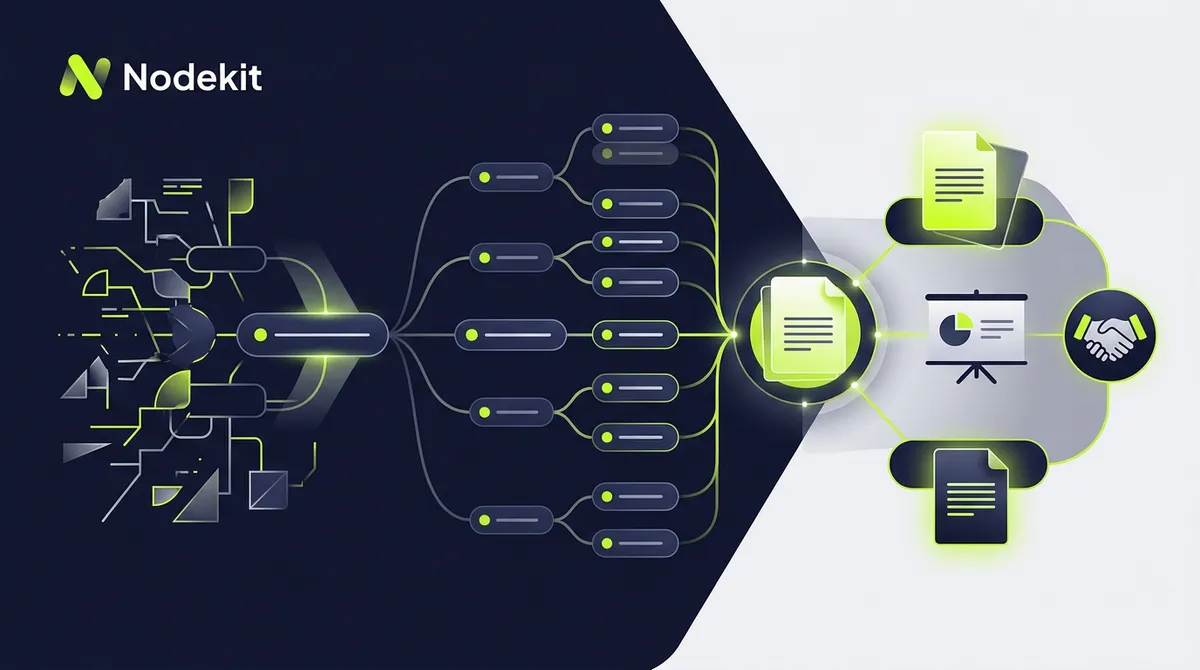
Consulting is one of the few professions where the deliverable format directly determines the client's perception of the engagement's value. A 60-page report suggests thoroughness. A 30-slide deck suggests structure. A visual mindmap suggests clarity of thinking -- the ability to see the entire strategic landscape and organize it into a framework the client can act on.
Clients pay for clarity. Consultants spend hours manufacturing it in PowerPoint and Miro. The analysis was done Tuesday. The visual that communicates it was built Thursday. The two-day gap is production overhead.
The Consulting Deliverable Economics #
Management consulting is a $330 billion global market (Source Consulting, 2025). The product is structured thinking delivered as visual artifacts. The economics of that delivery are broken.
A senior consultant at a mid-tier firm bills at $250-350/hour. The typical engagement produces 8-15 distinct visual deliverables: strategy maps, competitive landscapes, organizational assessments, process flows, implementation roadmaps, risk matrices, and stakeholder analyses. Each deliverable requires 2-4 hours of construction time after the analytical work is complete.
The math is straightforward. A 12-deliverable engagement with 3 hours average construction time per deliverable costs the firm 36 hours of production labor. At $300/hour billing rate, that is $10,800 in capacity that could have been spent on billable analysis or allocated to another engagement. If the construction time is unbillable (absorbed by the firm as overhead), it directly reduces engagement profitability by 15-25%.
For boutique firms -- the 5-50 person firms that serve the mid-market and represent 80% of consulting firms by count -- the overhead is proportionally larger. A four-person boutique billing 5,000 hours annually might spend 800-1,200 of those hours on visual deliverable construction. That is 16-24% of total capacity consumed by production work that adds no analytical value.
Why Consultants' Mindmap Needs Are Different #
Generic mindmap templates fail consultants for three specific reasons.
First, consultants need boardroom-ready output. A brainstorming mindmap with casual labels and uneven formatting works for internal meetings. It does not work for a $200/hour engagement where the client expects polished, professional deliverables that communicate expertise. Every node needs specific content. Every branch needs logical hierarchy. Every label needs the language the client's industry uses.
Second, consultants need framework-based structure. McKinsey's MECE principle, BCG's growth-share matrix, Porter's Five Forces, the Strategy Diamond -- these frameworks shape how consultants organize information. A mindmap tool that generates generic structures ignores the analytical frameworks that give consulting deliverables their intellectual rigor.
Third, consultants need speed at scale. A single engagement produces 8-15 deliverables. Each deliverable needs to be consistent with the others in style, depth, and terminology. Building 15 visuals manually means 15 instances of construction overhead, with the added challenge of maintaining visual consistency across all of them.
Templates Built for Consultants #
Business Plan Templates #
Full business plan deliverables with market sizing (TAM/SAM/SOM with methodology), competitive landscape, go-to-market strategy, financial projections, and risk assessment. Content uses the language of investor presentations and board materials -- LTV:CAC ratios, unit economics, cohort analysis -- because that is how consultants communicate financial strategy.
Use it for: Pre-funding strategic planning, new market entry analysis, annual strategy refresh.
See the Business Plan Template
Competitive Analysis Templates #
Multi-dimensional competitor profiles with pricing intelligence, feature matrices, customer sentiment analysis, and strategic positioning gaps. Includes the "whitespace analysis" branch that identifies market positions no competitor occupies -- the strategic recommendation that justifies the engagement fee.
Use it for: Competitive positioning engagements, M&A due diligence, product strategy advisory.
See the Competitive Analysis Template
Marketing Strategy Templates #
Go-to-market strategy deliverables with channel mix recommendations, budget allocation frameworks, campaign architecture, and measurement plans. Content includes the specific metrics and benchmarks that marketing directors use to evaluate strategy: CAC by channel, conversion rate benchmarks, attribution model selection.
Use it for: Fractional CMO engagements, marketing audit deliverables, GTM strategy projects.
See the Marketing Strategy Template
SWOT Analysis Templates #
Strategic SWOT deliverables that go beyond four labeled quadrants. Each quadrant contains specific, data-backed entries with "so what" implications. The fifth branch -- cross-quadrant analysis -- maps strength-opportunity matches and weakness-threat vulnerabilities into a prioritized action plan.
Use it for: Strategic planning retreats, board presentations, engagement kickoff alignment.
Organizational Assessment Templates #
Maps the client's organizational structure with role clarity analysis, skill gap identification, communication flow mapping, and change management readiness scoring. Each organizational node includes a diagnostic finding and a recommendation, not just a name and title.
Use it for: Organizational transformation projects, merger integration planning, leadership development programs.
How Consultants Actually Use Mindmaps #
Based on patterns from 1,800+ consultant-created mindmaps, the five most common use cases:
- Strategy deliverables for client presentations (38% of consultant mindmaps). The visual that anchors the client meeting. Replaces the 30-slide deck that takes 45 minutes to present with a single-page visual that communicates the strategic argument in 90 seconds. Branches become discussion points. Nodes become decision inputs.
- Internal alignment during engagement kickoff (22% of consultant mindmaps). Before the engagement begins, the consulting team maps the project scope, analytical approach, deliverable timeline, and client stakeholder landscape. The mindmap becomes the team's shared reference -- the artifact that prevents three consultants from duplicating research because each thought the other was covering a different area.
- Workshop facilitation frameworks (17% of consultant mindmaps). Consultants facilitate client workshops using pre-structured mindmaps. Each branch becomes a workshop module. Participants populate nodes during the session. The output is a structured artifact rather than a whiteboard of sticky notes that the consultant photographs and never references again.
- Proposal visuals (13% of consultant mindmaps). The engagement proposal includes a "sample deliverable" -- a mindmap that demonstrates the consulting team's understanding of the client's challenge. This preview of the deliverable quality differentiates the proposal from competitors who submit text-only proposals. Firms report 20-30% higher win rates on proposals that include visual deliverable samples.
- Knowledge management and IP capture (10% of consultant mindmaps). After an engagement, the consulting firm captures the analytical framework as a reusable mindmap template. The next engagement in the same industry starts with a foundation of structured thinking rather than a blank canvas. This IP accumulation reduces engagement delivery time by 15-25% for repeat industry work.
The Consulting Firm ROI Calculation #
Consider a 10-person consulting firm billing 12,000 hours annually at $275/hour average rate.
Current state: 20% of capacity (2,400 hours) spent on visual deliverable construction. Cost: $660,000 in absorbed overhead (if unbillable) or displaced billable capacity.
With Nodekit: Construction time reduced by 70% (from 2,400 hours to 720 hours). 1,680 hours recovered. At $275/hour, that is $462,000 in recovered billing capacity per year. Alternatively, that capacity allows the firm to take on 3-4 additional engagements per year without hiring.
Even a 50% reduction in construction time (conservative estimate, accounting for customization and refinement) recovers 1,200 hours -- $330,000 in billing capacity.
For a solo consultant billing $200/hour for 1,500 hours annually, the math scales proportionally: 300 construction hours x 70% reduction = 210 recovered hours = $42,000 in additional billing capacity.
Related Templates #
Explore more templates built for consulting workflows:
- Business Plan Mind Map - Full business planning
- Competitive Analysis Mind Map - Competitive intelligence
- Marketing Strategy Mind Map - Go-to-market deliverables
Browse all mind map templates.
Questions #
What is Nodekit? #
Nodekit generates complete, content-rich mindmaps from a plain-text description. You describe the deliverable you need -- "competitive analysis for a mid-market B2B SaaS company entering the UK market" -- and you get a finished map with market data, competitor profiles, positioning analysis, and strategic recommendations in every node.
Is this built specifically for consultants? #
Nodekit generates mindmaps across roles and industries. The content adapts to the consulting context: board-ready language, framework-based structure, data-backed nodes. A competitive analysis generated for a consultant contains investor-grade market data. The same topic generated for an in-house marketing team uses operational metrics.
Can I maintain my firm's visual branding? #
The deliverable content is the starting point. Colors, fonts, and layout can be customized to match your firm's visual identity. Consistent branding across all engagement deliverables is maintained without rebuilding each visual from scratch.
How is this different from consulting framework templates? #
Framework templates give you structure with empty nodes. Nodekit gives you structure with content. A Porter's Five Forces template from a consulting toolkit has five labeled branches and 25 empty sub-nodes. Nodekit generates five branches with 25 nodes of industry-specific competitive analysis.
When does Nodekit launch? #
We are in development now. Join the waitlist to be first to know.
What does it cost? #
We have not announced pricing yet. Waitlist members will receive founding member rates.
featuredImage: "/blog-images/mindmap-for-consultants-featured.webp" ogImage: "/blog-images/mindmap-for-consultants-featured.webp" #
Nodekit: Describe it. Done.
Related Pages
Mind Map Templates for Educators: Lesson Plans, Curricula, and Course Structures in One View
Educators spend 7-12 hours per week on lesson planning and curriculum documentation. The pedagogical thinking is the value. The visual construction is the overhead.
Mind Map Templates for Freelancers: Proposals, Strategies, and Deliverables Without a Team
Freelancers are a one-person firm. Every hour spent building a visual deliverable is an hour not spent on billable work or finding the next client.
Mind Map Templates for HR Managers: Org Charts, Onboarding Plans, and People Strategy in One View
HR managers create onboarding plans, org charts, training programs, and policy documents. Each one takes 45 minutes to build. The people strategy was finished before you opened the tool.
Mind Map Templates for Marketing Managers: Strategy Visuals in Seconds, Not Hours
Marketing managers create 4-8 strategy visuals per month. Each one takes 45 minutes to build manually. The strategy was done before you opened the tool.
Mind Map Templates for Product Managers: From Roadmap to Visual in 15 Seconds
Product managers live at the intersection of six teams. The visual deliverable that aligns them all should not take longer to build than the strategy behind it.