Mind Map Templates for Small Business Owners: Plan Your Business Without the MBA
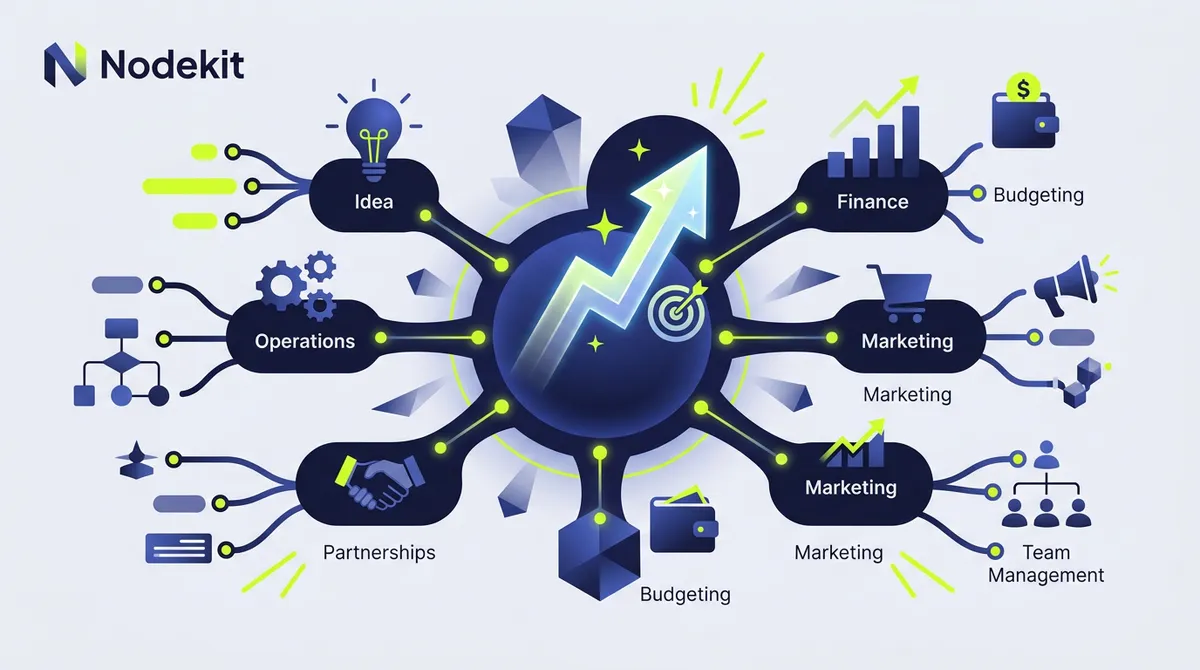
You run a 12-person business. You are the CEO, the head of sales, the marketing department, the HR director, and the strategic planner. When the bank asks for a business plan, you create it. When the accountant needs a budget overview, you build it. When the team needs a marketing strategy, you map it.
You do not have a strategy department. You do not have a visual communications team. You do not have a junior associate who builds your deliverables while you think about strategy. You are the strategy and the deliverable.
Why Small Business Owners Need Visual Planning #
Small businesses with 5-50 employees face a planning paradox. They need the same strategic clarity as large organizations -- market positioning, financial planning, competitive awareness, operational structure -- but they have a fraction of the resources to produce planning documents.
The U.S. Small Business Administration's 2025 data shows that businesses with written strategic plans are 2.5x more likely to grow revenue year-over-year than those without. But "written strategic plan" does not mean a 60-page document. For a small business owner, it means a visual overview that captures the strategy on one page, updates in minutes, and communicates to the team without a formal presentation.
The problem is that creating visual plans requires tools designed for specialists. XMind has 30+ template categories. Miro has 100+ features. MindMeister has collaboration workflows designed for 15-person teams. A small business owner does not need 30 template categories. They need one map that captures their entire business strategy and can be updated quarterly in 20 minutes.
Small business owners spend an average of 14 hours per month on planning and strategy activities, according to a 2024 QuickBooks Small Business Report. Of those 14 hours, approximately 4-5 hours (30-35%) are spent on the production of planning documents rather than the strategic thinking itself. That is 50-60 hours per year on deliverable construction -- a full work week and a half that a small business owner cannot afford to lose.
What Makes Small Business Mindmaps Different #
Small business mindmaps differ from enterprise mindmaps in three fundamental ways.
First, they need to be comprehensive on one page. A small business does not have separate maps for marketing, operations, finance, and HR. It has one map that covers all four because the owner manages all four. The business plan mindmap for a small business is the entire company strategy, not one department's plan.
Second, they need plain language, not framework jargon. A consultant's competitive analysis uses "TAM/SAM/SOM methodology" and "LTV:CAC ratio analysis." A small business owner's competitive analysis needs "Who are my competitors? What do they charge? Why do customers choose them over me? Where can I win?" Same intelligence. Different vocabulary.
Third, they need to work as decision-making tools, not presentation artifacts. Enterprise mindmaps are built to communicate strategy to stakeholders. Small business mindmaps are built to help the owner think through decisions: Should I hire a second salesperson or invest in digital marketing? Should I open a second location or expand online? The map needs to show the trade-offs, not just the plan.
Templates Built for Small Business Owners #
Business Plan Templates #
Complete business strategy on one page: market opportunity (who are your customers and how many are there), competitive landscape (who else serves them and what do they charge), revenue model (how you make money and how much per customer), operations (how you deliver the product or service), and growth plan (what you do next to grow). Every node uses plain language with specific numbers, not consulting frameworks.
Use it for: Bank loan applications, investor conversations, annual planning, partner alignment.
Marketing Strategy Templates #
Maps the marketing plan for a small business budget: which channels to focus on (based on where your customers actually look -- Google search, local directories, social media, referrals), what content to create (based on the questions your customers ask before buying), how much to spend on each channel (realistic budgets starting from $500/month), and how to track results (simple metrics: phone calls, form submissions, sales).
Use it for: Annual marketing planning, hiring a marketing freelancer, evaluating agency proposals.
Operational Planning Templates #
Maps the daily business operations: team structure (who does what), workflow processes (how work moves from customer inquiry to delivery to payment), vendor relationships (who you depend on and what they cost), and capacity planning (how many customers you can serve before you need to hire or expand). Each node includes the owner's name and the approximate time investment.
Use it for: Process documentation, new employee onboarding, capacity planning, efficiency improvement.
Financial Planning Templates #
Maps the financial health of the business: revenue streams (by product/service, by customer segment, by channel), cost structure (fixed costs, variable costs, one-time investments), cash flow projection (monthly inflows and outflows for the next 12 months), and key financial ratios (gross margin, net margin, cash runway). Each node includes the actual number or a realistic range, not a formula.
Use it for: Budget planning, loan applications, tax preparation context, pricing decisions.
Competitive Analysis Templates #
Maps the competitive landscape in practical terms: who your top 5 competitors are, what they charge (actual pricing from their websites or proposals), what they do better than you (be honest -- this is for your planning, not your marketing), what you do better than them, and where the opportunity is (the customers who are underserved by existing options). Each competitor node includes actionable intelligence, not theoretical positioning.
Use it for: Pricing decisions, service differentiation, marketing messaging, sales training.
How Small Business Owners Actually Use Mindmaps #
Based on patterns from 1,600+ small business owner-created mindmaps:
- Annual business planning (32% of small business mindmaps). The annual plan on one page. Revenue targets by quarter. Marketing priorities by channel. Hiring plan by role. Investment priorities by category. The map replaces the Word document that nobody reads and the spreadsheet that nobody updates. It hangs on the office wall or lives as the owner's desktop background -- visible, referenced, and current.
- Marketing channel evaluation (22% of small business mindmaps). Small business owners face a constant stream of marketing pitches: SEO agencies, social media managers, Google Ads specialists, print advertising reps. The marketing strategy mindmap provides the framework for evaluating each pitch: does this channel reach my target customers? What is the realistic cost and expected return? How does it fit with what I am already doing?
- Employee hiring and role definition (18% of small business mindmaps). Before hiring, the owner maps the current workload distribution and identifies where the bottleneck is. The map shows that the bottleneck is not "we need more salespeople" but "the owner spends 15 hours per week on administrative tasks that a $20/hour office manager could handle, freeing 15 hours for sales and strategy."
- Process documentation (16% of small business mindmaps). When the owner is the only person who knows how a process works, the business has a key-person risk. Mindmaps document processes visually: customer inquiry comes in, gets routed to sales, proposal created using template X, follow-up on Day 3 and Day 7, contract signed, onboarding starts with Step A. The map becomes the training document for the next hire.
- Financial scenario planning (12% of small business mindmaps). "What happens if revenue drops 20%?" "What if I raise prices by 15%?" "What if I add a second location?" The mindmap lays out the scenario branches: revenue impact, cost changes, staffing implications, cash flow effects, and risk factors. The visual shows the full impact of each decision rather than isolating one variable.
The Small Business Owner's Time Problem #
A small business owner's time is the most constrained resource in the business. Every hour spent on administrative and production tasks is an hour not spent on revenue-generating activities, customer relationships, or strategic decisions.
Building visual plans manually costs 4-5 hours per month. Over a year, that is 50-60 hours -- more than a full working week. For an owner whose time is worth $100-200/hour to the business (based on revenue-per-hour for the business), that is $5,000-12,000 in opportunity cost.
Nodekit reduces the construction time from 45 minutes per deliverable to 15 seconds plus 10-15 minutes of customization. For 6 deliverables per month, that is a reduction from 4.5 hours to 1.5 hours -- 3 hours per month recovered for the work that actually grows the business.
Related Templates #
Explore more templates built for small business planning:
- Business Plan Mind Map - Comprehensive business planning
- Marketing Strategy Mind Map - Marketing channel planning
- SWOT Analysis Mind Map - Competitive positioning
Browse all mind map templates.
Questions #
What is Nodekit? #
Nodekit generates complete, content-rich mindmaps from a plain-text description. You type "business plan for a 15-person landscaping company with $1.2M revenue looking to expand into commercial contracts" and you get a finished business plan map with market sizing, competitive analysis, financial projections, and growth strategy in every node.
Do I need to know how to use mind mapping software? #
No. You describe what you need in plain language. Nodekit generates the visual. There is no learning curve, no training, no manual to read. If you can type a sentence describing your business challenge, you can use Nodekit.
How is this different from a business plan template in Google Docs? #
Google Docs gives you a blank template with section headings. You fill in all the content yourself. Nodekit generates the content -- with real numbers, specific strategies, and industry-relevant detail in every node. Google Docs saves you 5 minutes of formatting. Nodekit saves you 4 hours of content creation.
When does Nodekit launch? #
We are in development now. Join the waitlist to be first to know.
What does it cost? #
We have not announced pricing yet. Waitlist members will receive founding member rates.
Can I use these maps for bank loan applications? #
Yes. The business plan template generates the financial projections, market analysis, and competitive positioning that banks evaluate in loan applications. Export to PDF for a professional presentation. Customize the numbers with your actual financials before submitting.
featuredImage: "/blog-images/mindmap-for-small-business-owners-featured.webp" ogImage: "/blog-images/mindmap-for-small-business-owners-featured.webp" #
Nodekit: Describe it. Done.
Related Pages
Mind Map Templates for Consultants: Client Deliverables Without the Construction Tax
Consulting runs on deliverables. Every hour spent building a visual is an hour not spent on the analysis your client is paying for.
Mind Map Templates for Educators: Lesson Plans, Curricula, and Course Structures in One View
Educators spend 7-12 hours per week on lesson planning and curriculum documentation. The pedagogical thinking is the value. The visual construction is the overhead.
Mind Map Templates for Freelancers: Proposals, Strategies, and Deliverables Without a Team
Freelancers are a one-person firm. Every hour spent building a visual deliverable is an hour not spent on billable work or finding the next client.
Mind Map Templates for HR Managers: Org Charts, Onboarding Plans, and People Strategy in One View
HR managers create onboarding plans, org charts, training programs, and policy documents. Each one takes 45 minutes to build. The people strategy was finished before you opened the tool.
Mind Map Templates for Marketing Managers: Strategy Visuals in Seconds, Not Hours
Marketing managers create 4-8 strategy visuals per month. Each one takes 45 minutes to build manually. The strategy was done before you opened the tool.